
Sourcing Guide
What Documents Should Architects Request Before Specifying Imported Materials? A Complete Checklist
A definitive checklist of essential technical documents architects and specifiers must request from material suppliers before finalizing specifications for Vietnam construction projects. Covers TDS, fire test reports, warranties, BIM files, and sustainability certifications.

What Documents Should Architects Request Before Specifying Imported Materials? A Complete Checklist
Specifying an imported construction material without a complete documentation package is one of the most common — and most costly — mistakes in the Vietnamese construction and design industry. It leads to project delays (when materials fail site inspection), cost overruns (when incompatible materials must be replaced), contractor disputes (when installation fails due to undisclosed substrate requirements), and in the worst cases, serious safety liabilities (when materials without verified fire ratings are installed in life-safety-critical locations).
This is not a rare scenario. It is, in fact, the default outcome when materials are sourced through informal channels — trading agents without technical capability, social media specification sourcing, or direct manufacturer websites with marketing PDFs presented as technical documentation.
This guide provides a definitive specification document checklist for architects, interior designers, and procurement teams working on construction projects in Vietnam. Use it as a standard evaluation framework for every new product you are considering for specification.
Why Documentation Matters More Than You Think
The Gap Between Manufacturer Claims and Tested Performance
Manufacturer marketing materials routinely describe product performance using superlatives that may or may not reflect independently verified test results. Common examples:
- "Fire resistant" ≠ a classified fire reaction rating per EN 13501-1
- "Weatherproof" ≠ a tested UV resistance result per EN ISO 4892-2
- "10-year warranty" ≠ a written warranty document specifying coverage scope, exclusions, and claims process
Without independently verified test reports and legally binding warranty documents, you are relying on a marketing claim that has no enforceable basis.
Vietnam Regulatory Context
Vietnam's construction regulatory framework (QCVN 06:2022/BXD for fire safety; QCVN 09:2017/BXD for energy efficiency; Circular 06/2021/TT-BXD for material quality management) increasingly references international standards. Inspectors at the permit and certificate-of-occupancy stages are increasingly likely to request:
- Fire reaction certificates for wall and ceiling cladding materials in public areas
- Energy performance data for glazing systems and insulation materials
- Country-of-origin documentation for imported materials
Projects that cannot produce this documentation risk delayed certificates of occupancy and compulsory removal or replacement of non-compliant materials.
Category 1: Must-Have Documents (Non-Negotiable)
These documents must be in your possession before you include any material in a project specification. Their absence is an automatic disqualifier.
1. Product Technical Datasheet (TDS)
The Technical Datasheet is the foundational document for any material specification. It must contain:
Required content in a compliant TDS:
- Product name and exact product code / SKU
- Physical properties: dimensions (with tolerances ±mm), weight per m², thickness range
- Mechanical properties: compressive strength, flexural strength, impact resistance (ASTM or EN method reference)
- Thermal properties: thermal conductivity (λ), U-value (where applicable)
- Chemical composition (at minimum, hazardous substance disclosure)
- Surface properties: hardness, gloss level, slip resistance rating
- Installation requirements: substrate type, adhesive type, fixing schedule, joint requirements
- Environmental operating range: temperature, humidity
Red flags in a TDS:
- Document dated more than 5 years ago (product formulation may have changed)
- No test standard references (data without methodology is unverifiable)
- Missing dimensional tolerances (critical for site fit and compatibility)
- No contact detail for technical support
Why it matters: Without a TDS, your structural engineer cannot verify whether the material weight is within floor loading capacity; your MEP engineer cannot confirm compatibility with your specified adhesives and sealants; your contractor cannot price the installation correctly.
2. Fire Reaction Test Report (Fire Performance Certificate)
Fire performance documentation is the most safety-critical document class in material specification.
Vietnam compliance pathway:
| Product Category | Required Standard | Issuing Body |
|---|---|---|
| Interior wall cladding (public areas) | EN 13501-1 Euroclass | Notified Body + local QUATEST verification |
| Ceiling panels and tiles | EN 13501-1 Euroclass | Notified Body |
| Facade cladding systems | EN 13501-1 + EN 13823 (SBI) | Notified Body |
| Floor coverings | EN 13501-1 (Efl classification) | Notified Body |
| Insulation materials | EN 13501-1 Euroclass | Notified Body |
| Timber and wood-based products | EN 13501-1 with ASTM E84 accepted | Either standard |
Fire classification guide (EN 13501-1):
| Euroclass | Performance | Typical Applications |
|---|---|---|
| A1 | Non-combustible | Concrete, steel, glass, mineral wool |
| A2-s1,d0 | Limited combustibility | Gypsum board, some fiber cement |
| B-s1,d0 | Very limited contribution to fire | Acoustic panels, some HPL |
| C-s2,d0 | Limited contribution to fire | Some timber products |
| D-s3,d2 | Medium contribution | Untreated timber |
| E | Flammable | Combustible products — avoid in public areas |
| F | No performance determined | No test — do not specify |
Critical requirement: The test report must be issued by an accredited testing laboratory (EN ISO/IEC 17025 accredited). A manufacturer's self-declaration is not acceptable as a fire performance certificate.
Vietnam-specific note: QCVN 06:2022/BXD requires that fire test reports be recognized by Vietnamese authorities. Certificates from Vietnamese testing bodies (QUATEST 1, 2, 3) are accepted directly; certificates from international bodies (Warrington Fire, BRE, RISE, MPA Dresden) are accepted if accompanied by a Certificate of Conformity issued by a Vietnam-recognized body or the manufacturer's authorized Vietnamese distributor.
3. Installation Manual (Technical Installation Guide)
The Installation Manual must provide unambiguous step-by-step guidance for contractors installing the product on a Vietnam construction site.
Compliant installation manual contents:
- Required substrate conditions (flatness tolerance, moisture content, strength)
- Surface preparation procedures (cleaning, priming, leveling)
- Required adhesive, grout, or fixing system specifications (with named products)
- Fixing schedules and patterns (fastener type, spacing, penetration depth)
- Joint design requirements (expansion joints, movement joints, sealed joints)
- Subframe specifications where applicable (aluminum profile sizes, fixing intervals)
- Environmental conditions during installation (minimum temperature, humidity)
- Sequence of operations and curing/drying time requirements
- Post-installation protection requirements
Why it matters: Imported materials frequently have installation requirements that differ significantly from Vietnamese site practice. A facade cladding system designed for a specific proprietary rail system cannot be installed on locally fabricated brackets — regardless of what a contractor claims. Incorrect installation routinely voids the product warranty and can create structural safety risks.
4. Warranty Document
A warranty has no legal value without a written document specifying its precise terms.
Minimum compliant warranty document contents:
- Warranty period (in years, from date of installation)
- Warranty scope (exactly what is covered: material defects, finish degradation, dimensional stability)
- Warranty exclusions (what is NOT covered: installation errors, inadequate maintenance, specific chemical exposure)
- Performance guarantees (where applicable — e.g., gloss retention ≥ 60% at 10 years)
- Claims process (who to contact, within what time frame, what evidence is required)
- Jurisdiction (which country's law governs warranty disputes)
- Contact details of warranty administrator in Vietnam (or authorized local representative)
Red flag: "10-year warranty" stated in a brochure or marketing email with no accompanying warranty document = zero legal value.
5. Material Safety Data Sheet (MSDS / SDS)
Required for any material containing potentially hazardous substances — adhesives, coatings, composite materials, treated wood products, resins.
The SDS must conform to GHS (Globally Harmonized System) format (16 sections) and disclose hazardous substance content, safe handling procedures, PPE requirements, and emergency response procedures.
Category 2: Should-Have Documents (Important)
Collect these before finalizing procurement. Their absence should prompt follow-up with the supplier.
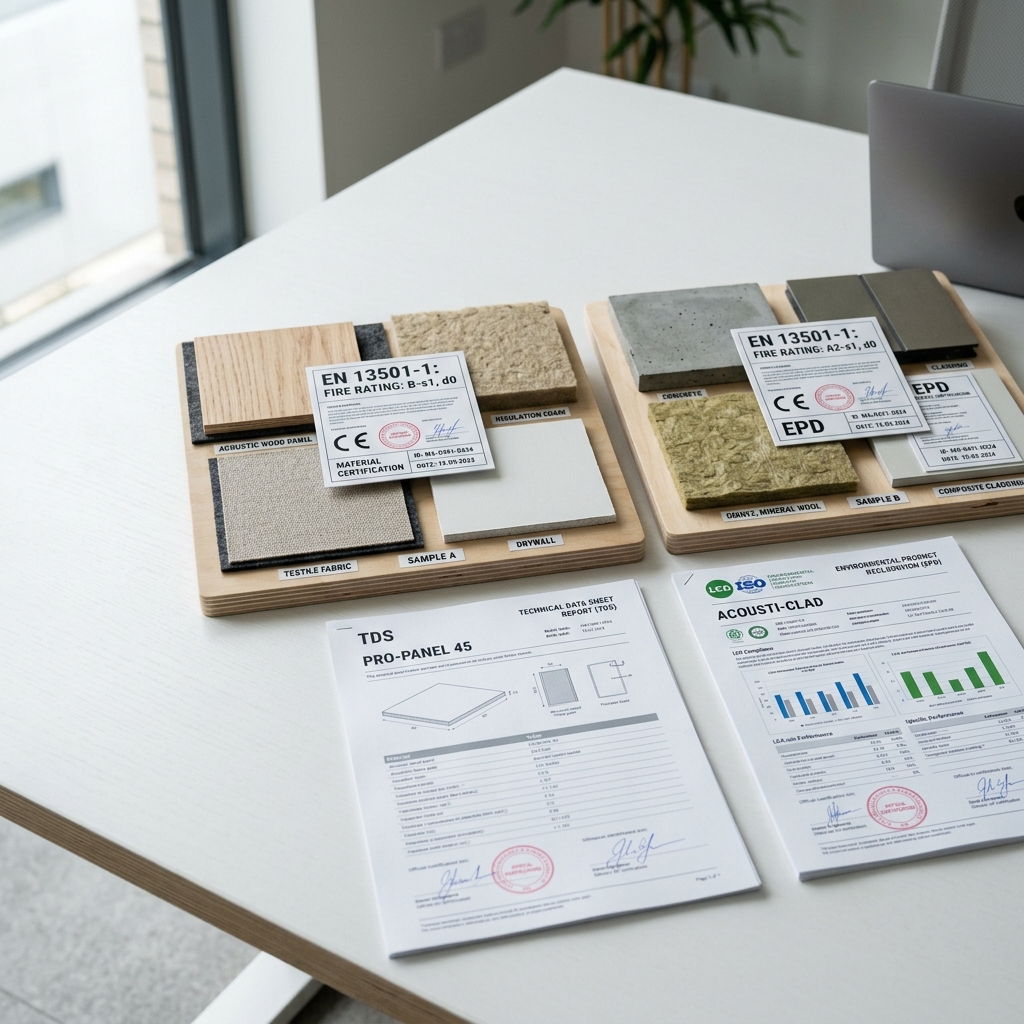
6. Reference Project Portfolio
Before specifying an imported product for a major project, request:
- Photographs of completed installations using the same product in comparable applications
- Location and contact details of at least 2 completed reference projects (ideally in Southeast Asia or similar climate)
- Year of installation (allowing assessment of long-term performance)
Why it matters: A product successfully installed in a Scandinavian climate may perform very differently in Vietnam's tropical conditions. Southeast Asian reference projects are particularly valuable.
7. MOQ and Lead Time Confirmation (Written)
| Information Required | Why It Matters |
|---|---|
| Minimum Order Quantity (MOQ) | Determines whether small-quantity orders are feasible without cost penalty |
| Production lead time (from order confirmation) | Critical path impact assessment |
| Shipping time to Vietnam port (by sea) | Typically 15–30 days from Europe; 5–10 days from China |
| Incoterms (EXW / FOB / CIF / DAP) | Determines who bears freight cost and risk |
| Port of discharge (Cat Lai / Hai Phong / Da Nang) | Import duty rates vary by HS code and origin |
Warning: Many imported building materials have production lead times of 8–16 weeks from Europe. If the project schedule does not accommodate this lead time, the material cannot be specified without risk of construction delay.
8. Physical Material Sample
A physical sample — not a digital image, not a reference to a local showroom sample — is essential before finalizing specification.
Minimum sample requirements:
- Size: ≥ 300×300 mm (or full module size for smaller products)
- Finish: Must represent the exact finish, color, and texture of the ordered product
- Labeling: Must include product code, batch reference, and manufacturer contact
- Quantity: Request minimum 3 samples for client presentation, project file, and contractor reference
Important: Specify that physical samples must match the production batch within SDCM 3 (color) and ±5% (gloss) of the approved sample. Include this requirement in your Letter of Intent or purchase order.
9. CAD / BIM Files
Digital product files enable integration of the material specification into your project documentation workflow.
| File Format | Purpose |
|---|---|
| DWG / DXF | 2D CAD — typical fixing details, installation sections |
| RVT (Revit Family) | 3D BIM — for clash detection and visualization |
| IFC | Open BIM — interoperability with all BIM platforms |
| IES (for luminaires) | Photometric data — lighting simulation |
| PDF Specifications | Outline specifications for insertion into project specification documents |
10. Maintenance Guide
The maintenance guide specifies how the product should be cleaned, maintained, and if necessary, repaired over its lifetime.
Contents to verify:
- Recommended cleaning products and concentrations
- Cleaning frequency (daily maintenance vs deep clean interval)
- Products to AVOID (important for stone, surface coatings, and finishes that may be damaged by harsh chemicals common in Vietnam's cleaning supply chain)
- Repair procedures for minor damage (scratches, chips)
- Replacement component availability (fixings, capping profiles, service parts)
Category 3: Nice-to-Have Documents (Pursue for Certified Projects)
11. Environmental Product Declaration (EPD)
An EPD is an independently verified, standardized document that quantifies the environmental impact of a product across its lifecycle (production, installation, use, and end-of-life), expressed in standard impact categories including Global Warming Potential (kg CO₂-eq).
When required:
- LEED v4.1 Materials & Resources Credit: Building Product Disclosure and Optimization (BPDO) — requires EPDs from manufacturers representing ≥ 20 permanently installed building products
- LOTUS v3 Green Building Rating — sustainability documentation credit
- Corporate ESG reporting for developer clients
EPD types:
- Industry-average EPD (covers product category averages — weakest)
- Product-specific EPD (covers specific product — strongest, most credible)
- Third-party verified EPD (required for LEED credit)
12. Sustainability Certifications
| Certification | Product Category | Issuing Body |
|---|---|---|
| FSC / PEFC | Timber and wood-based products | Forest Stewardship Council / PEFC International |
| Cradle to Cradle (C2C) | All product categories | Cradle to Cradle Products Innovation Institute |
| Declare Label (Living Building Challenge) | All product categories | ILFI |
| BlueSign | Textiles and fabrics | BlueSign Technologies |
| Indoor Air Quality (GREENGUARD Gold) | Interior products, adhesives | UL Environment |
Document Readiness Evaluation Matrix
Use this matrix when evaluating a new supplier or product:
| Document | Priority | Status |
|---|---|---|
| Technical Datasheet (TDS) | 🔴 Must Have | ☐ Received / ☐ Not yet |
| Fire Test Report (EN 13501-1) | 🔴 Must Have | ☐ Received / ☐ Not yet |
| MSDS / Safety Data Sheet | 🔴 Must Have | ☐ Received / ☐ Not yet |
| Installation Manual | 🔴 Must Have | ☐ Received / ☐ Not yet |
| Warranty Document | 🔴 Must Have | ☐ Received / ☐ Not yet |
| Reference Projects (≥ 2) | 🟡 Should Have | ☐ Received / ☐ Not yet |
| MOQ + Lead Time (written) | 🟡 Should Have | ☐ Received / ☐ Not yet |
| Physical Sample | 🟡 Should Have | ☐ Received / ☐ Not yet |
| CAD / BIM Files | 🟡 Should Have | ☐ Received / ☐ Not yet |
| Maintenance Guide | 🟡 Should Have | ☐ Received / ☐ Not yet |
| EPD (for certified projects) | 🟢 Nice to Have | ☐ Received / ☐ Not yet |
| Sustainability Certification | 🟢 Nice to Have | ☐ Received / ☐ Not yet |
Common Documentation Problems and How to Resolve Them
| Problem | Root Cause | Resolution |
|---|---|---|
| TDS is marketing brochure, not technical document | Supplier has no technical capability | Request TDS from manufacturer directly; avoid intermediaries without technical staff |
| Fire test report is for different product thickness | Test was for specific configuration | Request test report for your exact specified thickness and configuration |
| Warranty document is in foreign language only | No local legal entity | Request certified translation; confirm warranty administrator in Vietnam |
| No BIM files available | Manufacturer has not invested in BIM | Request generic system BIM family + manufacturer DWG details as substitute |
| Lead time conflict with project schedule | Specification started too late | Accelerate procurement process; discuss stock availability; identify alternative in-stock products |
| Physical sample color differs from digital image | Digital color representation is not calibrated | Always make decisions from physical samples; reject digital-only approvals |
How HIASHI Solves the Documentation Problem
Collecting, verifying, and organizing these documents for every product in a project specification is a substantial administrative burden — particularly for complex projects with 50–100+ specified materials across multiple categories.
HIASHI's AI Material Platform addresses this systematically:
- Brand Onboarding Process: Every brand that enters the HIASHI network must submit a complete documentation package as a condition of listing. This includes TDS, fire test reports, installation manuals, and warranty documents — verified by HIASHI's technical team.
- Brand Knowledge Hub: All documentation is organized and accessible through HIASHI's platform, allowing architects to download verified documents directly without chasing suppliers.
- Documentation Gap Alerts: When a document is missing or expired, HIASHI's system flags it automatically.
- BIM File Library: IES, RVT, and DWG files from verified brands are available for direct download.
Submit an RFQ → — When you source through HIASHI, every recommended product comes with a complete, pre-verified documentation package. No chasing. No surprises at the inspection stage. Submit your material requirements and receive a curated, fully documented shortlist within 48 hours.
Talk to AI Advisor → — If you are evaluating a supplier or product that is not yet in the HIASHI network, our AI Material Advisor can guide you through the documentation checklist, identify what is missing, assess documentation risk level, and suggest verified alternatives from within the platform. Free to use, available 24/7.
Need material guidance for a project?
Share the technical brief so HIASHI can support material shortlisting, samples, TDS and RFQ preparation.