
Material Guide
Architectural Lighting & Smart Control Systems: The Complete Specification Guide
A comprehensive guide to architectural lighting design, LED specification parameters (CCT, CRI, UGR), DALI smart control systems, and Human Centric Lighting (HCL) for hospitality, office, retail, and healthcare projects.
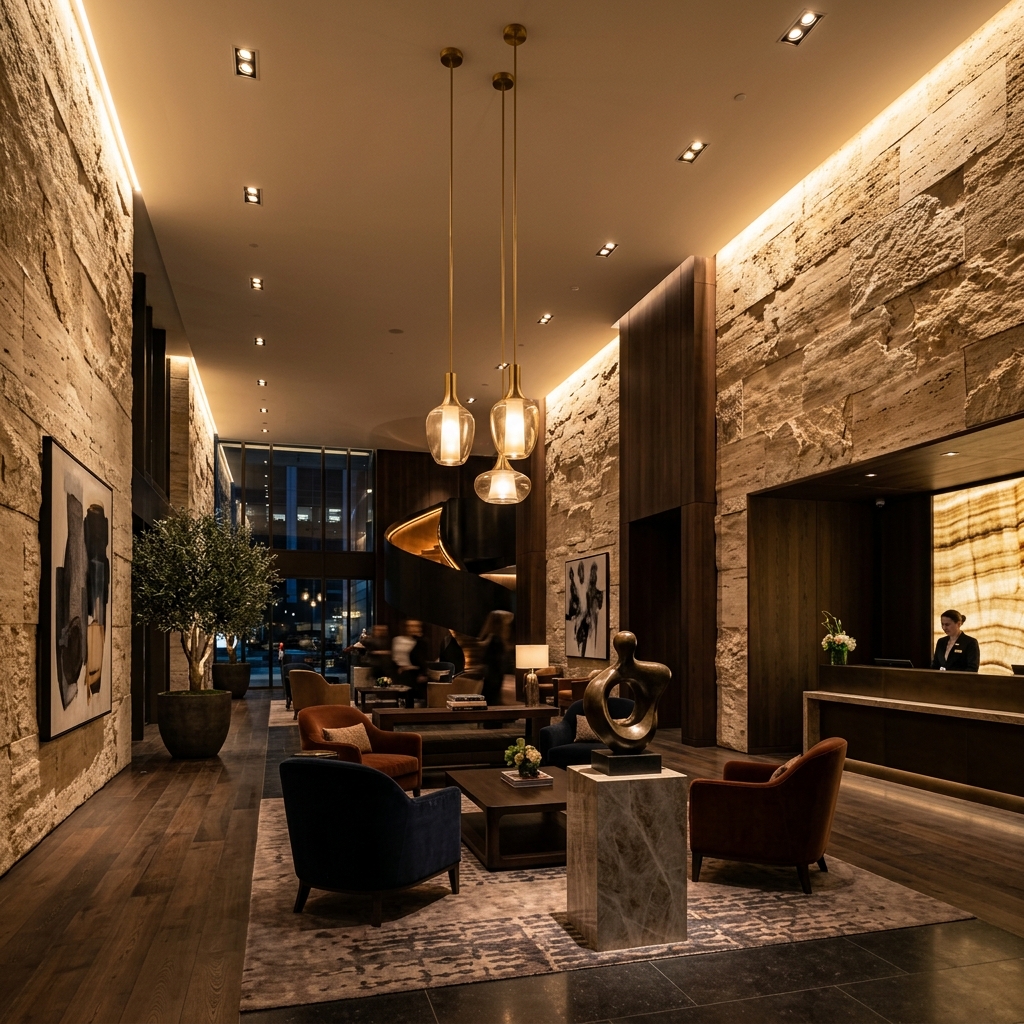
Architectural Lighting & Smart Control Systems: The Complete Specification Guide
Light is the single most powerful tool an architect or interior designer has to define the character, quality, and emotional impact of a space. A room with exceptional materials and precise proportions can be rendered mediocre by poor lighting; conversely, intelligent lighting design can elevate even modest spaces into memorable experiences.
Yet lighting specification remains one of the most technically complex disciplines in the built environment. The vocabulary is dense — CCT, CRI, UGR, DALI, LM80, TM21, IP ratings, dimming protocols — and the consequences of specification errors are expensive to rectify once construction is complete.
This guide is designed to give architects, interior designers, and project managers a rigorous foundation for lighting specification, from first principles to procurement strategy.
1. The Three Layers of Architectural Lighting
Every successful lighting design strategy operates across three distinct layers, each serving a different human and spatial function.
1.1 Ambient (General) Lighting
Ambient lighting provides the base illuminance level that allows all activities within a space to function safely. It should be even, glare-controlled, and capable of dimming to support different times of day and use scenarios.
Typical targets (EN 12464-1):
- Open-plan offices: 500 lux at desk height
- Hotel corridors: 50–100 lux
- Retail (general): 200–300 lux
- Restaurant/bar: 50–150 lux
- Hospital ward (night mode): 10–30 lux
1.2 Task Lighting
Task lighting supplements ambient illuminance at specific functional locations — workstations, kitchen counters, reception desks, reading chairs. It must be positioned to avoid veiling reflections and shadows on the working surface.
Key specification parameters:
- Directionality: avoid casting shadow from the user's working hand
- Dimming capability: allow individual user adjustment
- CCT: match or complement ambient lighting layer
1.3 Accent Lighting
Accent lighting creates visual interest, drama, and hierarchy within a space by directing higher-intensity beams at specific surfaces, objects, or architectural features. A well-specified accent layer transforms a room from "adequately lit" to "designed."
Accent lighting applications:
- Grazing a textured stone wall to reveal surface depth and shadow
- Washing a timber-paneled reception wall with uniform vertical illumination
- Framing artwork with adjustable track spots (typically 3–5× the ambient illuminance level)
- Highlighting a feature material — GKD metal mesh, travertine, terrazzo — with precisely aimed beams
2. Critical LED Specification Parameters
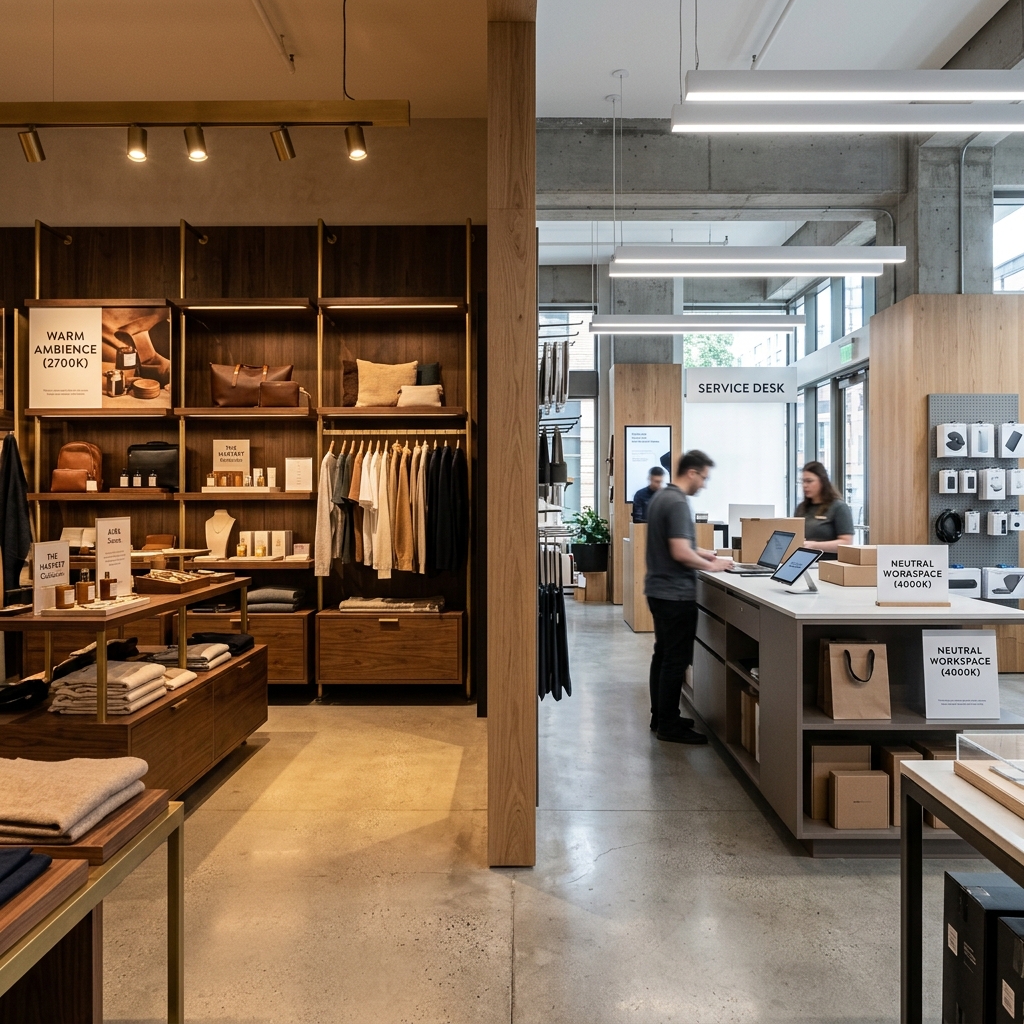
2.1 Correlated Color Temperature (CCT)
CCT is measured in Kelvin (K) and describes the "warmth" or "coolness" of a light source's apparent color. It is one of the most impactful decisions in the lighting specification process.
| CCT Range | Character | Recommended Applications |
|---|---|---|
| 1800K – 2200K | Candlelight / fire | Intimate dining, bars, spa |
| 2700K | Warm white | Luxury hotels, resorts, residential, F&B |
| 3000K | Soft white | Boutique retail, high-end hospitality, museum |
| 3500K | Intermediate | Lobbies, upscale retail |
| 4000K | Cool white / neutral | Offices, general retail, schools |
| 5000K – 6500K | Daylight | Hospitals, factories, technical spaces |
Critical specification note: Specify CCT tolerance as ±100K maximum and SDCM (Standard Deviation Color Matching) ≤ 3 for premium installations. Without this constraint, luminaires from the same manufacturer can appear noticeably different in color — an embarrassing outcome on a luxury hotel project.
2.2 Color Rendering Index (CRI)
CRI measures a light source's ability to accurately reveal the true colors of surfaces and objects, relative to an ideal reference source. Measured on a scale from 0 to 100.
| CRI Value | Color Rendering Quality | Application |
|---|---|---|
| CRI < 60 | Poor | Industrial storage only |
| CRI 60–79 | Acceptable | Basic utility spaces |
| CRI 80–89 | Good | Standard offices, classrooms |
| CRI ≥ 90 | Excellent | Retail, museums, hospitality |
| CRI ≥ 95 | Premium | Medical, luxury retail, art galleries |
R9 value: For applications involving red tones (food, skin, artwork), separately specify R9 ≥ 50 (ideally R9 > 80). CRI is an average of R1–R8 and does not capture red-tone rendering; a luminaire can achieve CRI 90 with a poor R9 value.
Recommendation: For any hospitality, retail, or luxury residential project, specify CRI ≥ 90 and R9 ≥ 50 as minimum thresholds.
2.3 Unified Glare Rating (UGR)
UGR quantifies the discomfort glare experienced by a standard observer in a given installation, calculated from the luminaire's luminous intensity distribution, the room geometry, and the reflectance values of surfaces.
| UGR Value | Glare Level | Recommended Applications |
|---|---|---|
| < 10 | Imperceptible | Luxury residential |
| < 16 | Negligible | Drawing offices, precision work |
| < 19 | Acceptable | Open-plan offices (EN 12464-1 requirement) |
| < 22 | Moderate | Industrial, general storage |
| < 25 | High | Very short tasks only |
Specification requirement: For office projects pursuing WELL Building Standard v2 or LEED v4.1 credits, specify UGR < 19 for all luminaires in task areas and provide IES files for visual comfort simulation in Dialux or Relux.
2.4 IP Rating (Ingress Protection)
The IP rating defines a luminaire's resistance to solid particle and liquid ingress.
| IP Code | Protection Level | Typical Application |
|---|---|---|
| IP20 | No protection | Dry interior ceiling |
| IP44 | Splash-proof | Bathroom (Zone 2), kitchen |
| IP54 | Dust & splash | Semi-outdoor, covered terraces |
| IP65 | Dust-tight & water jet | External facade lighting |
| IP67 | Immersion up to 1m | In-ground uplighters |
| IP68 | Continuous immersion | Underwater pool lighting |
2.5 Lumen Maintenance (LM80 / TM21)
LED luminaires degrade over time. LM80 is the IESNA test protocol measuring lumen depreciation; TM21 is the calculation method that extrapolates lifetime from LM80 data.
Specify: L80B10 at minimum 50,000 hours for commercial applications (lumen output remains ≥ 80% of initial with no more than 10% failure rate at 50,000 operating hours).
3. Dimming Technologies
Dimming is essential for energy management, scene-setting, and Human Centric Lighting. Different dimming protocols offer different levels of sophistication and cost.
| Dimming Protocol | Minimum Dim Level | Flicker | Cost Level | Integration |
|---|---|---|---|---|
| Triac (Phase-cut) | 10–20% | Moderate risk | Low | Basic |
| 0-10V (1-10V) | 10–15% | Low | Low-medium | Standard commercial |
| PWM | 0.1% | High risk | Low | LED strips only |
| DALI | 0.1% | Negligible | Medium-high | Full BMS integration |
| Casambi / Bluetooth | 0.1% | Negligible | Medium | Wireless retrofit |
| KNX | 0.1% | Negligible | High | Premium BAS integration |
For office, hotel, and high-end retail projects: specify DALI-2 (the updated standard with enhanced device feedback capability).
4. Smart Lighting Control Systems
4.1 DALI (Digital Addressable Lighting Interface)
DALI is the global standard for digital lighting control. Each DALI device has a unique 6-bit address (up to 64 individual addresses per line), enabling independent control of every luminaire in a system.
DALI-2 advantages over original DALI:
- Standardized device profiles for drivers, sensors, and push buttons
- Bidirectional communication — the controller receives status feedback
- Enhanced interoperability between different manufacturers
Typical DALI system components:
- DALI-2 power supply / gateway
- DALI-2 LED drivers (integrated into luminaires)
- DALI-2 occupancy and daylight sensors
- DALI-2 push button/touch panel controllers
- BMS/BACS integration interface
4.2 Occupancy & Daylight Harvesting Sensors
An effective sensor strategy can reduce lighting energy consumption by 30–45%:
- Occupancy sensors (PIR/microwave): Reduce light level to 10% within 5 minutes of detecting no movement; increase to setpoint instantly on detection
- Daylight harvesting sensors: Continuously dim artificial light in proportion to available daylight, maintaining a constant illuminance level at the working plane
- Sensor placement: One sensor per 10–15 m² of floor area for reliable occupancy coverage
4.3 Human Centric Lighting (HCL)
HCL — also known as Circadian Lighting — dynamically adjusts both CCT and illuminance throughout the day to align with human circadian rhythms, supporting alertness, health, and sleep quality.
Typical HCL scene sequence:
| Time | CCT | Illuminance | Effect |
|---|---|---|---|
| 06:00 – 09:00 | 4000–5000K | 300–500 lux | Gentle wake-up, alertness |
| 09:00 – 12:00 | 5000–6000K | 500–750 lux | Peak focus, productivity |
| 12:00 – 14:00 | 4000K | 400–500 lux | Lunchtime transition |
| 14:00 – 17:00 | 4500–5000K | 500 lux | Afternoon alertness boost |
| 17:00 – 21:00 | 3000–3500K | 200–300 lux | Wind-down |
| 21:00 – 06:00 | 2700K | < 50 lux | Melatonin-safe mode |
Applications: Offices, hospitals, care homes, schools, residential. HCL is increasingly required for WELL Building Standard v2 certification and is a differentiating feature for premium workplace projects.
5. IES Files and Lighting Simulation
Before finalizing a lighting specification, every project should undergo photometric simulation using IES files (IESNA) from the specified luminaires.
- Software: Dialux Evo (free), Relux (free), AGi32 (commercial), ACAD Lighting (AutoCAD plugin)
- Output deliverables: False-color illuminance maps, uniformity ratios (Uo), average maintained illuminance calculations, UGR tables
- IES file sourcing: Request from manufacturer's technical team or via HIASHI's Brand Knowledge Hub
6. Vietnam-Specific Considerations
6.1 Power Quality and Flicker
Vietnam's power grid in some locations experiences voltage fluctuations. Specify LED drivers with:
- Power Factor (PF) ≥ 0.90 (active PF correction)
- Total Harmonic Distortion (THD) < 10% for commercial installations
- Flicker Percent < 5% and Flicker Index < 0.1 (mitigate photosensitive epilepsy risk and productivity impairment)
6.2 Humidity and Tropical Durability
- Specify conformal-coated PCBs on LED drivers for areas with seasonal humidity above 85% RH
- For outdoor facade luminaires in coastal resort projects (Da Nang, Phu Quoc, Nha Trang): specify IP66 minimum + marine-grade aluminum housing for salt air resistance
- Tropical heat (ambient temperatures 35–40°C) reduces LED driver lifespan; specify maximum ambient rating (ta) ≥ 50°C
6.3 Vietnam Electrical Standards
Vietnam follows TCVN electrical standards, which are aligned with IEC. Ensure specified luminaires carry:
- CE marking (or equivalent IEC compliance)
- LM79 photometric test report for claimed lumen output verification
- ROHS compliance for imported products
7. Specification Checklist Summary
| Parameter | Minimum Requirement | Premium Target |
|---|---|---|
| CRI | ≥ 80 | ≥ 90, R9 ≥ 50 |
| CCT tolerance | ±200K | ±100K, SDCM ≤ 3 |
| UGR | < 22 | < 19 |
| Lumen maintenance | L80B10 @ 35,000 hrs | L80B10 @ 50,000 hrs |
| Dimming protocol | 0-10V | DALI-2 |
| Power factor | ≥ 0.85 | ≥ 0.95 |
| Flicker | < 20% | < 5% |
| IP rating (outdoor) | IP54 | IP66 |
Ready to Specify? HIASHI Can Help.
With thousands of luminaire SKUs from global brands, the lighting specification process is one of the most error-prone stages of any project. HIASHI's AI Material Platform streamlines procurement and verification:
Submit an RFQ → — Send your lighting schedule (lamp type, CCT, CRI, IP rating, dimming protocol, quantity) and receive competitive quotations from verified lighting brands with full technical documentation, IES files, and LM80 test reports.
Talk to AI Advisor → — Ask HIASHI's AI Advisor to recommend luminaires for a specific space type, compare DALI control systems, identify value-engineering alternatives to specified brands, or verify technical parameters against EN 12464-1 requirements. Instant response, 24/7 availability.
Tìm kiếm nguồn cung vật liệu này?
Gửi yêu cầu báo giá (RFQ) trực tiếp tới mạng lưới nhà cung cấp BCP của HIASHI.