
Material Comparison
Fibre Cement vs Aluminium Composite Panels: Which Should You Specify?
A detailed technical comparison from HIASHI between fibre cement board (FCB) and aluminium composite panel (ACP) for facade cladding — covering fire safety, durability, cost, weight, and suitability for Vietnam's tropical climate.
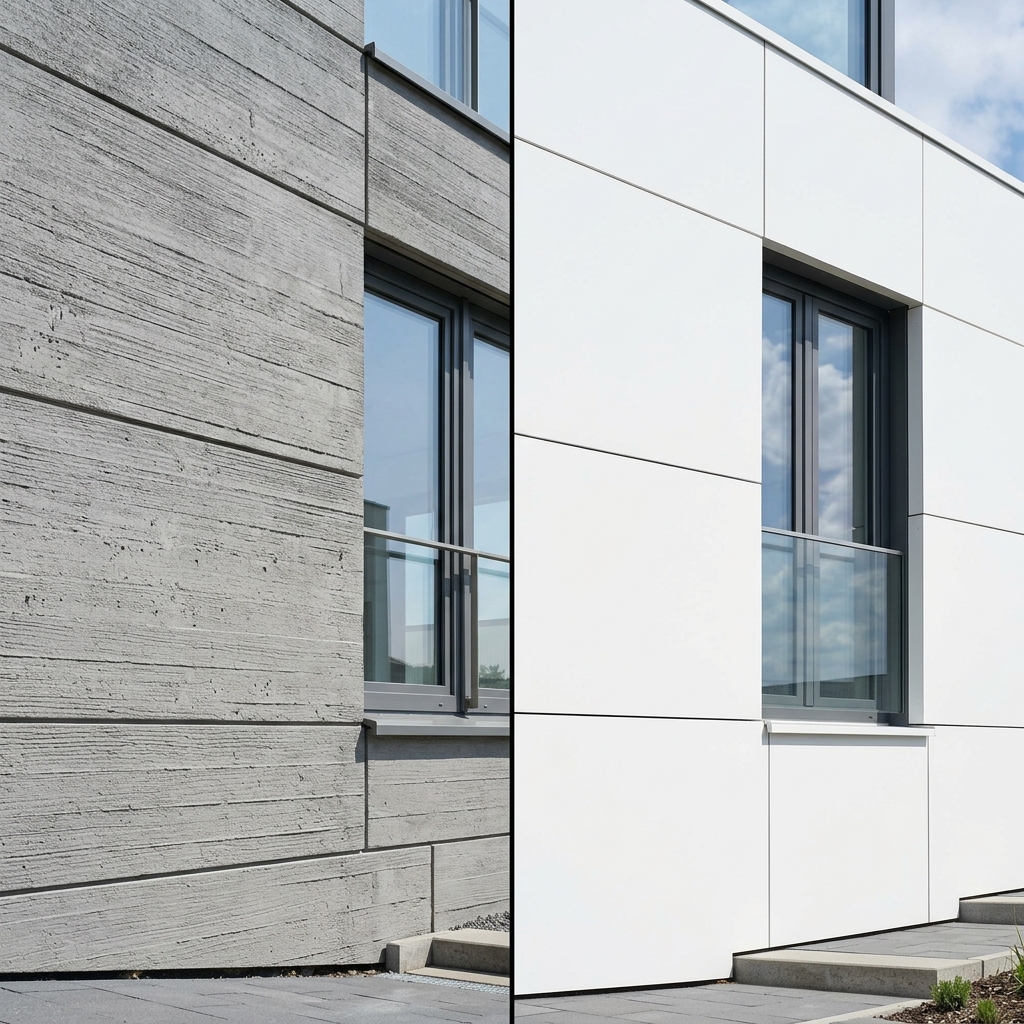
Fibre Cement vs Aluminium Composite Panels: Which Should You Specify?
Two materials dominate Vietnam's facade cladding market: fibre cement board (FCB) and aluminium composite panel (ACP). Both are widely available, competitively priced, and broadly suitable for tropical climates — yet they perform very differently in specific conditions, and the wrong choice can lead to costly maintenance, fire safety issues, or premature failure.
This comparison cuts through the noise and gives architects and contractors the technical basis to make the right specification decision.
Head-to-Head Technical Comparison
| Property | Fibre Cement Board (FCB) | Aluminium Composite Panel (ACP) |
|---|---|---|
| Core material | Cement + cellulose fibers | PE or mineral core + aluminium skins |
| Density | 1.2–1.6 g/cm³ | 0.5–0.7 g/cm³ |
| Weight (8mm) | ~14–17 kg/m² | ~5–6 kg/m² |
| Fire classification | A2-s1,d0 (non-combustible) | A2 (mineral core) or B–C (PE core) |
| UV resistance | Excellent (with PVDF finish) | Excellent (PVDF coated skins) |
| Moisture resistance | Excellent | Excellent |
| Impact resistance | Very good | Good (dents under point load) |
| Thermal expansion | Low | High (aluminium expands significantly) |
| Max panel size | 3600×1200mm | 4000×1500mm |
| Color options | Limited (painted) | Very wide (PVDF coating, 200+ colors) |
| Machinability | Can be cut with standard tools | Requires metal cutting tools |
| Recyclability | Low | High (aluminium is recyclable) |
| Cost (FOB Vietnam) | USD 8–18/m² | USD 10–25/m² (A2 core) |
| Typical warranty | 10–15 years | 10–20 years |
1. Fire Safety: The Critical Differentiator
This is the most important factor and the one most often overlooked in Vietnamese procurement.
Fibre Cement Board
FCB is inherently non-combustible — cement and mineral fibers do not burn. Premium brands achieve Class A1 or A2-s1,d0 (EN 13501-1), meaning they contribute zero fuel to a fire. This makes FCB suitable for facades of any height without restriction.
Aluminium Composite Panel
ACP's fire performance depends entirely on the core material:
| ACP Core Type | Fire Class | Vietnam Regulation (QCVN 06:2022) |
|---|---|---|
| Polyethylene (PE) | B2–C | Prohibited on buildings > 28m height |
| Fire-Retardant (FR) | B-s3,d0 | Permitted up to 28m only |
| Mineral-filled (A2) | A2-s1,d0 | Permitted all heights |
Critical Note for Vietnam: After several high-rise fires in Southeast Asia linked to PE-core ACP, Vietnam's QCVN 06:2022/BXD tightened regulations significantly. Always verify the core type from the manufacturer's test certificate — not just the sales specification.
2. Weight & Structural Impact
FCB is significantly heavier than ACP. For a 1,000m² facade:
- FCB at 8mm: ~14,000–17,000 kg of dead load on the subframe
- ACP at 4mm: ~5,000–6,000 kg of dead load
This weight difference has real implications:
- Heavier subframe required for FCB (higher structural cost)
- Higher seismic load contribution from FCB
- For high-rise facade retrofits, ACP is often preferred due to weight constraints
3. Aesthetics & Design Flexibility
| Design Factor | FCB | ACP |
|---|---|---|
| Surface textures | Wood grain, stone, smooth, brushed | Smooth, metallic, brushed, mirror |
| Curved applications | Limited (requires scoring) | Excellent (can be roll-formed) |
| Large format panels | Up to 3.6m length | Up to 4.0m length |
| Joints | Typically expressed (shadow gap) | Can be flush-jointed |
| Color matching | Custom factory paint to RAL | Standard PVDF to RAL or Pantone |
ACP wins on design flexibility, particularly for curved facades and large-format seamless-look installations. FCB wins on textural variation and natural material aesthetics.
4. Long-Term Maintenance
Both materials are low-maintenance when correctly specified and installed. Key differences:
- FCB may show efflorescence (white mineral staining) if moisture penetrates poor joints — correct installation is critical
- ACP joints must be sealed with high-quality silicone to prevent water ingress into the aluminium skin/core interface; failed sealant is the primary failure mode
- ACP dents under point-load impact (scaffolding, hail, vandalism) and cannot be repaired invisibly; panels must be replaced
- FCB cracks rarely if installed with correct movement joints, but edge chipping is possible during handling
5. Decision Framework
Choose FCB when:
- Building height > 28m and A1 fire class required
- Textural or natural material aesthetic is the design intent
- Budget for structural subframe allows for the weight
- Coastal/salt environment demands inorganic materials
Choose ACP (A2 mineral core) when:
- Lightweight facade is required (retrofit, high-rise)
- Curved or complex geometrical facade is specified
- Large, flat, high-gloss metallic panels are the design intent
- Speed of installation is a priority
Avoid PE-core ACP in all cases for exterior facades of permanent buildings.
6. Vietnam Market Availability
Both materials are readily available in Vietnam through HIASHI's BCP sourcing network. Premium FCB brands (Swisspearl, James Hardie, Etex) and A2-core ACP (Alucobond A2, Arconic Reynobond A2, local A2 brands) can be sourced with full technical documentation.
Tìm kiếm nguồn cung vật liệu này?
Gửi yêu cầu báo giá (RFQ) trực tiếp tới mạng lưới nhà cung cấp BCP của HIASHI.